
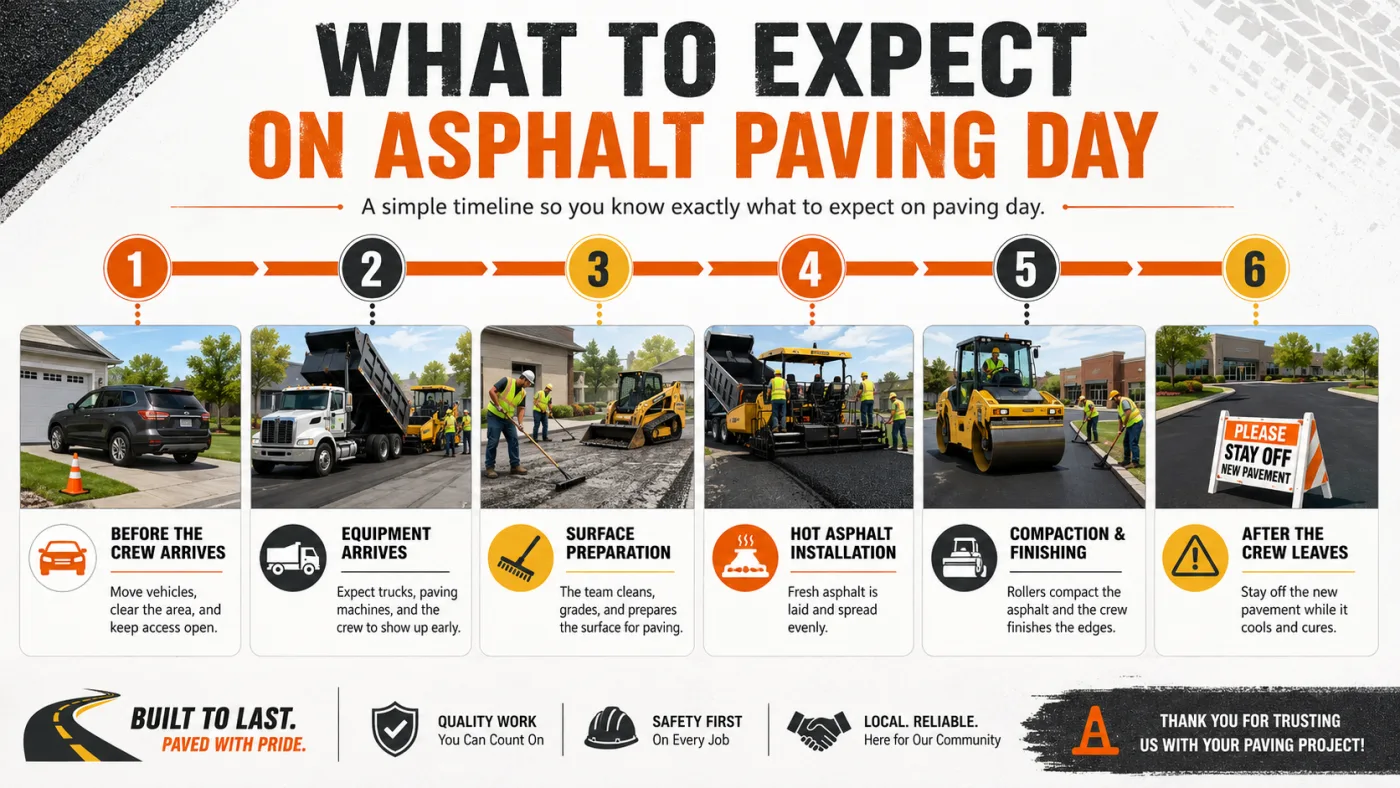
For most homeowners, paving day is a once-every-20-years event. It's also surprisingly involved — equipment, materials, multiple crew members, noise, smell, and a driveway that's unusable for a couple of days. Knowing what's coming makes the whole thing less stressful. Here's the play-by-play.

The day before
Most of the preparation has happened in the days before paving day. By the day before, you should expect:
- Communication confirming the schedule. Weather can shift things by a day or two — paving doesn't happen in heavy rain.
- Instructions for parking. You won't be able to use the driveway for 48–72 hours. Make a plan: street parking, neighbor's driveway, garage if accessible from the street.
- Vehicle removal. All vehicles out of the driveway and garage by morning. Anything you might need has to be parked elsewhere.
- Pet plan. Dogs in particular need to be kept off the surface for at least 24 hours. Plan accordingly.
Early morning: equipment arrives
Crews typically start between 7:00 and 8:00 AM. The equipment that shows up depends on the job, but for a typical residential driveway:
- Skid steer or small dozer — for removing existing pavement (if you're replacing rather than overlaying) and shaping the base
- Plate compactor or small roller — for base compaction
- Tack coat sprayer — applies a thin tack of liquid asphalt to bond new asphalt to underlying surfaces
- Paving machine (paver) — the main equipment that lays the asphalt
- Steel-wheel roller — compacts the new asphalt
- Rubber-tire roller — finishes the surface for a smooth final texture
- Dump truck(s) — deliver hot asphalt from the plant
For a typical residential driveway, you'll see 3–5 pieces of equipment and a crew of 4–6 people.
The work, hour by hour
Hour 1–2: Prep and removal
If your project is a full replacement, this is when the existing driveway gets removed. The skid steer scrapes up old asphalt, which is loaded into a truck and hauled away. For an overlay, this stage is shorter — the existing surface is just cleaned and prepped.
Hour 2–4: Base work
The sub-base is graded, regraded if needed, and compacted. This is the structural foundation of the new driveway, and it determines longevity. A good crew spends time here. If your project is an overlay rather than a replacement, this is the cleaning and tack stage instead.
Hour 4–5: Tack coat and edges
A thin layer of liquid asphalt (the tack coat) is sprayed onto the prepared base. It's black, sticky, and smells strong for a few hours. The tack coat is what bonds the new asphalt to the surface below — skipping or skimping on it is a common cause of poor adhesion.
Edges along the garage door, sidewalks, and grass are also prepped and edged.
Hour 5–7: Paving
This is the part that looks like paving. The dump truck pulls up, dumps hot asphalt into the paver's hopper, and the paver walks slowly across the driveway laying a uniform layer of fresh asphalt at the designed thickness. Crew members rake out the edges and corners by hand. The fresh asphalt is approximately 300°F.
You'll notice the smell. Hot asphalt has a distinct petroleum smell that's stronger right around the equipment and fades quickly with distance. It dissipates within a few hours.
Hour 7–9: Compaction
The steel-wheel roller passes over the new asphalt repeatedly, compacting it to design density. Then the rubber-tire roller passes over to seal the surface texture. Compaction is where the asphalt gets its strength — a poorly compacted driveway will fail in 5–8 years no matter how nice it looks.
Hour 9–10: Cleanup and final inspection
Equipment is loaded out. The crew walks the surface looking for any imperfections, edges that need additional rolling, or spots that need a final pass with the hand roller. They'll usually walk it with you and explain anything that's normal versus anything you should keep an eye on.
What the day sounds and smells like
- Noise: Moderate. The paver and rollers run constantly but aren't extremely loud. Less noise than tree removal, more than landscaping.
- Smell: Strong petroleum smell during the paving and tack coat stages, fading within an hour or two after the work is done.
- Smoke: Hot asphalt produces visible steam/vapor in cool weather. It's just water vapor — not smoke. You'll see plumes coming off the surface for an hour or so after placement.
- Vibrations: Minor. The rollers transmit some vibration to nearby ground but it's not usually noticeable inside the house.
What you should do during the work
- Stay out of the work zone. Hot asphalt is genuinely hot. Heavy equipment is moving constantly. Watch from the porch or sidewalk.
- Keep pets and kids indoors or away. Same reason.
- Available for questions. The foreman may need to confirm details — finished height at garage thresholds, sidewalk transitions, drainage decisions. Be reachable.
- Don't water your lawn. Sprinklers on the new surface during the cure can cause problems.
After the crew leaves
You'll have a beautiful new black driveway and a list of things to be careful about:
- Don't walk on it for 24 hours. Foot traffic before then leaves impressions.
- Don't drive on it for 48–72 hours. The asphalt is firm but still curing.
- No sharp turns from a stop for the first few weeks. Pivoting tires leave marks.
- No heavy vehicles (moving trucks, dumpsters, RVs) for 2 weeks. Concentrated loads can dent the surface.
- Wait 6–12 months before sealcoating. The asphalt needs to fully cure first.
The bottom line
A residential paving day is a single big day — 8 to 10 hours of work, a noticeable amount of equipment and noise, and a strong smell of fresh asphalt for a few hours. Then it's done. Two days of careful living and you're back to normal, except with a driveway that should last you a couple of decades.