
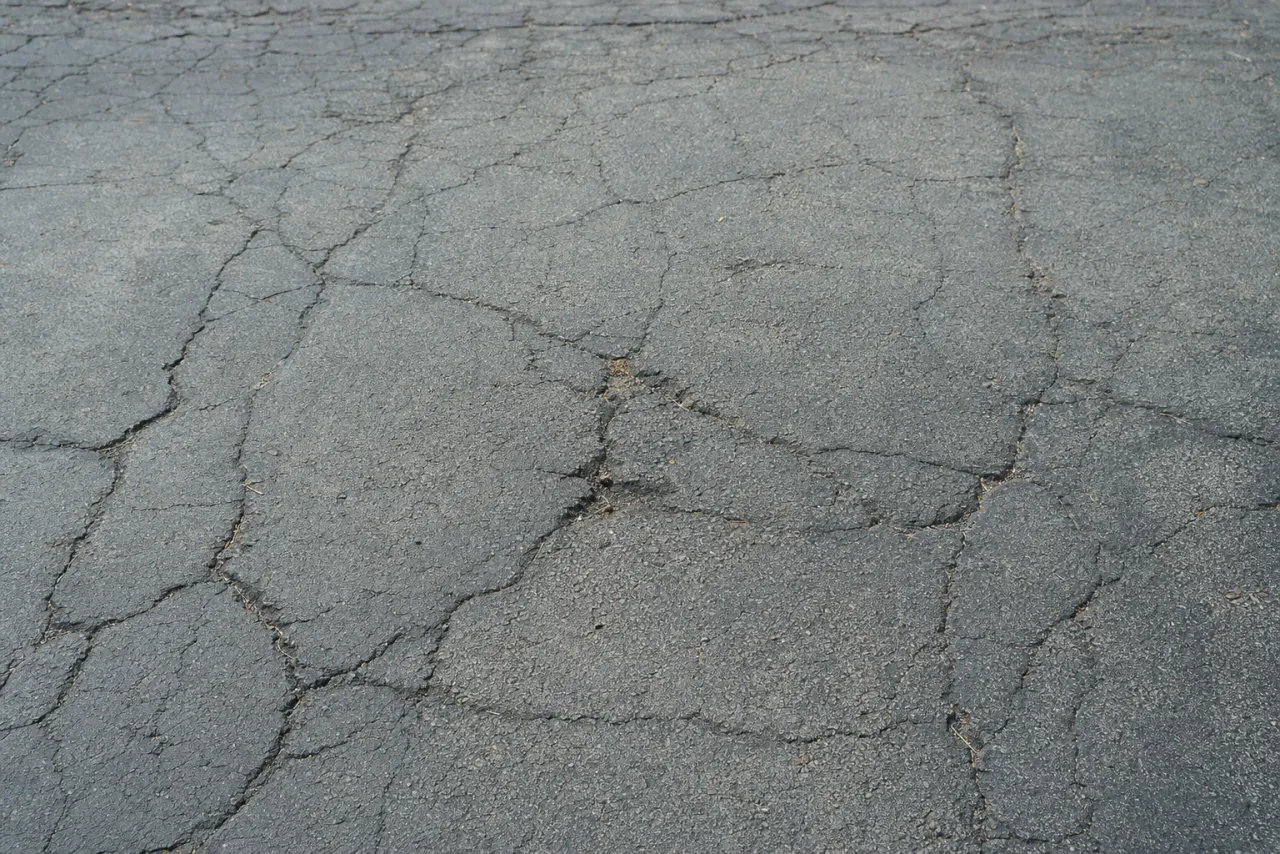
All asphalt cracks. The question is which kind, why, and whether it's a 15-minute fix or a sign of something bigger underneath. Here's how to read your driveway.
The five common crack types
1. Shrinkage cracks (random, hairline)
What it looks like: Thin, irregular lines that meander across the surface, often in a vaguely web-like pattern. Each crack is narrow — under 1/8".
Cause: Asphalt slowly shrinks as it ages and the binder oxidizes. Normal.
Fix: Sealcoating handles surface-level shrinkage. Wider shrinkage cracks (over 1/8") need crack-fill.
2. Edge cracks (parallel to the edge of the driveway)
What it looks like: A long crack 6–18 inches in from the edge, running parallel to the boundary.
Cause: Lack of support at the edge. Often combined with poor drainage that erodes the soil under the edge of the pavement.
Fix: Fill the crack, then address what's eroding the support. Sometimes that's a regrade, sometimes it's an edge curb or apron.
3. Transverse cracks (straight across, perpendicular to direction of traffic)
What it looks like: A roughly straight crack running across the driveway.
Cause: Thermal contraction. As asphalt cools in winter, it shrinks longitudinally. The surface can't move freely, so it cracks. Very common in the freeze-thaw belt.
Fix: Standard crack-fill if under 1/2" wide. Wider cracks may need routing first.
4. Longitudinal cracks (straight, parallel to direction of traffic)
What it looks like: A straight crack running the length of the driveway.
Cause: Usually a "paving joint" — the seam between two passes of the paver — that wasn't sealed well during installation, or aged faster than the surrounding pavement.
Fix: Crack-fill. These tend to come back, so plan on routing every few years.
5. Alligator cracking (interconnected, hexagonal)
What it looks like: A patch of tight interconnected cracks resembling alligator skin.
Cause: Base failure. The structural layer underneath the asphalt has lost its bearing capacity — usually because of water, poor compaction, or overloading.
Fix: This is the only crack type that cannot be surface-treated. Alligator cracks signal that the base has failed in that spot. Crack-filling or sealcoating will hide it for one season and accelerate the underlying failure. Proper repair means saw-cut, remove the bad section, re-establish the base, and replace the asphalt.
Why catching cracks early matters
The lifecycle of an untreated crack goes:
- Crack forms at the surface.
- Water enters during the next rain.
- Water freezes (we get 30–50 freeze-thaw cycles a year in the Piedmont) and expands the crack.
- Wider crack lets in more water.
- Water reaches the sub-base. Sub-base softens and loses bearing capacity.
- Surface begins to fail in alligator pattern.
- Pothole forms.
The entire spiral can be stopped at step 1 with a $0 sealcoat application or step 2 with a $0.10/linear foot crack-fill. After step 5 you're looking at a structural repair.
The crack-fill decision rule
- Under 1/8": Sealcoat covers it.
- 1/8"–1/2": Crack-fill (rubberized hot pour or self-leveling cold pour).
- Over 1/2": Route the crack to create a clean reservoir, then fill. Sometimes needs a band of patch material on top.
- Alligator pattern: Skip the surface treatment. Saw cut and repair the base.
When to call vs. DIY
Standard transverse or longitudinal cracks can be handled with cold-pour crack filler from any hardware store — clean, fill, smooth, done. Where it gets worth calling someone:
- Cracks wider than 1/2" that need routing.
- Anything that looks like alligator pattern.
- Cracks combined with depressions, water pooling, or visible base material showing through.
- You'd rather spend 30 minutes on the phone than half a Saturday on your knees.
The bottom line
Cracks aren't failures — they're feedback. Most are normal age. A few are warnings. Spending five minutes learning which is which can save you thousands.