
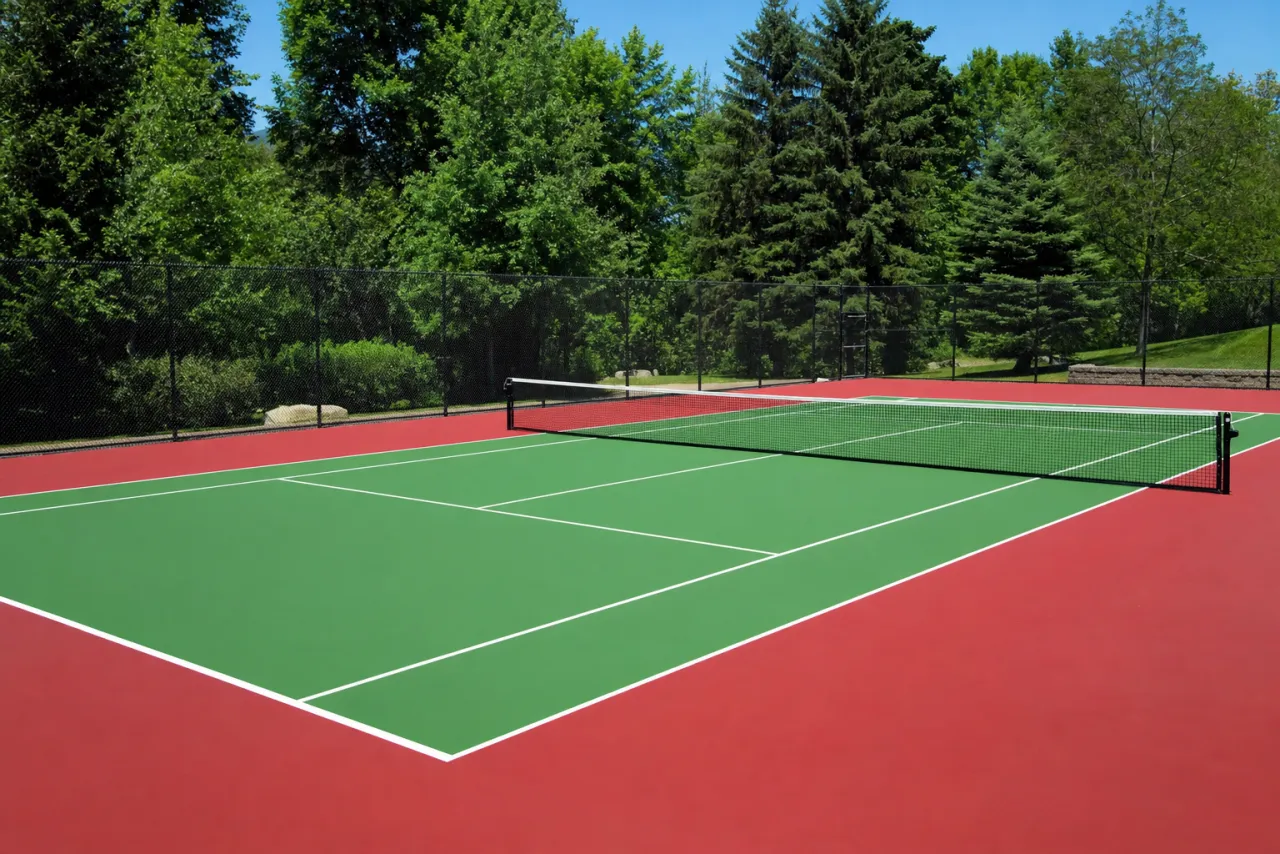
A tennis court that's been well-maintained can run 30+ years before needing a full rebuild. The trick is catching the right moment to resurface — the difference between a court that gets 10 more years from a $15,000 resurface and one that needs a $60,000 rebuild is usually 18 months of paying attention.
Resurface vs. rebuild — what's the difference?
Resurface
Existing asphalt or concrete base stays. The old acrylic color coat is stripped or roughened up, cracks are repaired, and a fresh color coating system is applied. Lines are restruck. The court is back in play in 1–2 weeks.
Adds 8–15 years to court life. 30–50% the cost of a rebuild.
Rebuild
Everything comes out. The base is removed, the sub-grade is regraded, new aggregate base is placed, new asphalt is laid, then the color system goes on top. The court is unusable for 2+ months.
Starts a fresh 20–30 year clock. Right answer when the base has failed.
The signals that say "resurface"
These point to a court where the base is still doing its job and only the surface needs work:
- Surface cracking only. Hairline cracks across the surface, but no alligator pattern.
- Faded or worn color. The acrylic coat has lost its grip texture or has weathered to a flat color.
- Player complaints about footing. Surface texture has degraded; balls take different bounces in different spots.
- Lines fading. Lines that have lost their crispness even after recent restriking.
- Court is structurally flat. Drains in a single direction without water collection issues.
- Court is 8–15 years since last resurface. Normal lifecycle for an acrylic system in our climate.
The signals that say "rebuild"
These point to base or drainage failure that can't be fixed at the surface:
- Alligator cracking. Interconnected hexagonal cracks tell you the base under that section has lost bearing capacity. Resurfacing over alligator pattern reflects up through the new surface within 2 years.
- Settlement. Visible dips, low spots, or differential heights between sections. The court has moved relative to itself — a structural issue.
- Standing water 24+ hours after rain. Drainage has failed. Surface work won't fix it.
- Wide cracks that move with weather. Cracks that open and close seasonally are reactive to base movement, not surface aging.
- Multiple previous patches showing through. Each new patch fails faster than the last — a sign of compounding base damage.
- 30+ years old with no major work done. Even if it looks okay, the structural section has been stressed for too long.
The middle ground: crack repair with fabric overlay
There's a partial option that works for courts with moderate cracking but otherwise sound bases. A non-woven geotextile fabric is laid over the existing surface with a leveling course, then the color system is applied over the fabric. The fabric "absorbs" small movements that would normally crack a resurface.
This buys 5–8 more years on courts that would otherwise need a rebuild, at maybe 60–70% of the resurface cost. It's not magic — if the base is truly failing, the fabric eventually telegraphs the cracks too — but it's a smart middle option for borderline cases.
The resurfacing process
A typical resurface goes:
- Inspection and crack mapping. Document every existing crack, low spot, and surface issue.
- Pressure washing. Strip old coatings, dirt, and loose material.
- Crack repair. Route, clean, and fill each crack appropriate to its width.
- Low-spot leveling. Fill any birdbaths with an acrylic patching compound.
- Resurfacer coat. 1–2 coats of acrylic resurfacer to even the surface and provide a base for the color system.
- Color coating. 2 coats minimum, applied with squeegee. Player area vs. surround can be two different colors.
- Texture additive. Silica sand mixed into the final coat for grip.
- Line striking. White lines applied with court paint and templates.
Color choices
The most popular modern combinations:
- US Open blue with green surround: The standard tournament look.
- Green inside, green surround: The traditional country club look.
- Custom branded colors: Common at universities, country clubs, and corporate facilities.
The color you choose has no impact on play; it's purely aesthetic. The surface texture and slope are what matter for performance.
Common questions
"My court has just one bad crack — can we fix just that?"
Yes. Single-crack repair is a small job. The catch is that if the crack is caused by base movement, it'll come back. Surface-only cracks tend to stay fixed.
"How often does a court need resurfacing?"
Every 8–12 years for outdoor courts in the Piedmont, depending on use intensity and maintenance. Heavy-use club courts trend toward the shorter end.
"Can I convert my tennis court to pickleball during a resurface?"
Yes. This is one of the most common requests right now. You can do dedicated pickleball striping, blended-line multi-use, or full tennis-to-pickleball conversion. The resurfacing work is the same; only the line striking changes.
The bottom line
Tennis courts are forgiving structures if you read them right. Surface complaints get a resurface. Base complaints get a rebuild. The middle case — significant cracking but sound base — has options. Pay attention to the cracking pattern more than the cracking quantity, and you'll know which conversation to have.