
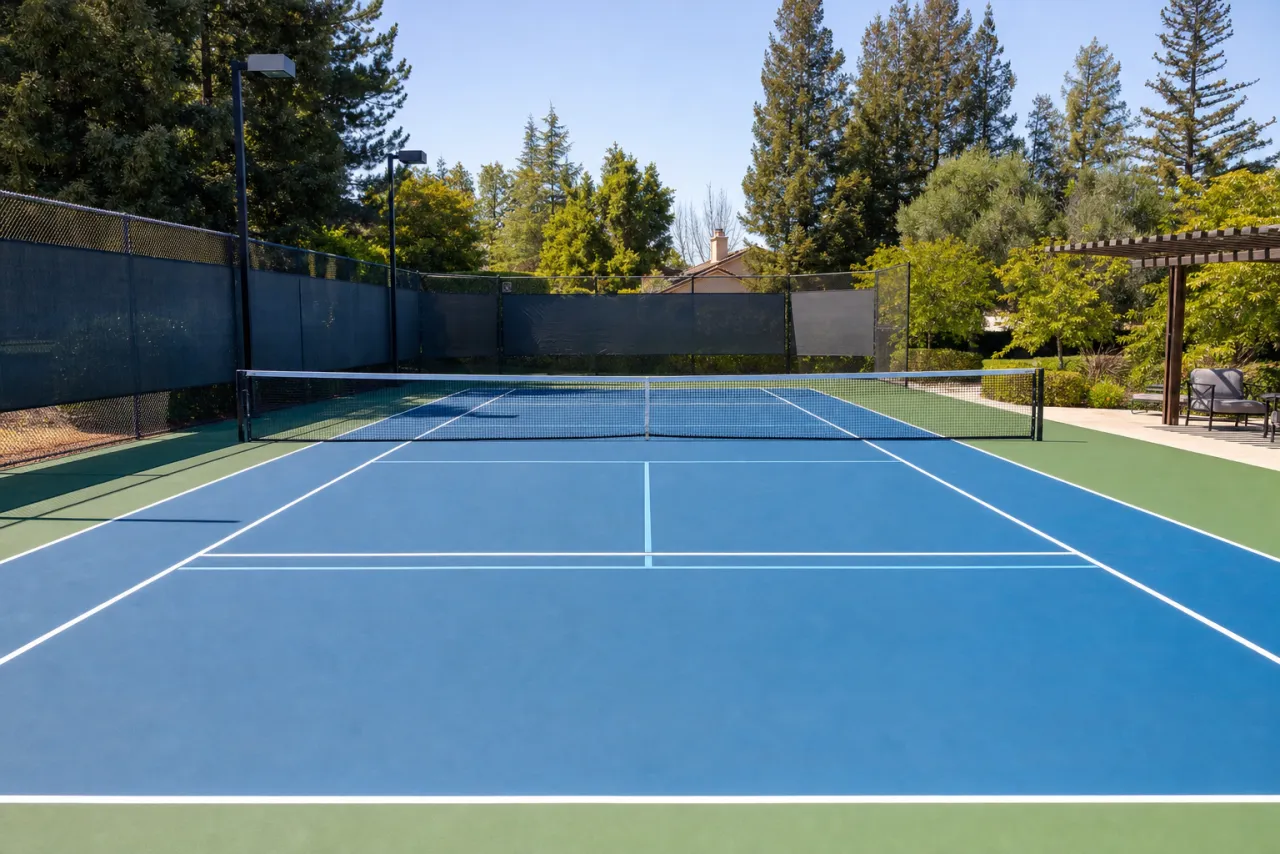
If you have a tennis court at your home, HOA, or club, you're sitting on the easiest pickleball conversion in the industry. The geometry works out almost perfectly — and depending on your priorities, the same court can serve tennis, pickleball, or both. Here's the conversion playbook.
The geometry: one tennis court = up to four pickleball courts
A standard tennis court is 60 feet wide by 120 feet long (including the surround). A regulation pickleball court is 30 × 60 feet (recommended total area).
Run the math: 60 ÷ 30 = 2 wide, 120 ÷ 60 = 2 long. One tennis court fits exactly four pickleball courts in a 2×2 grid.
You can also configure:
- 1 tennis court + 1 pickleball court: Use part of the surround for a pickleball court while keeping the tennis court intact.
- 1 tennis court + 2 pickleball courts: Two pickleball courts run perpendicular to the tennis baselines, sharing the playing area.
- 4 pickleball courts only: Full conversion, no tennis.
- Tennis with blended pickleball lines: Same striped court serves both sports.
Three conversion approaches
Option 1: Blended lines (cheapest, fastest)
The tennis court keeps its tennis lines, and pickleball lines are added in a contrasting color (typically a lighter blue or yellow against the green/blue acrylic). Both sports use the same surface.
Pros: Cheap. Quick — 1–2 days of work. Preserves tennis play.
Cons: Both sports' players have to mentally filter out the other sport's lines. Some tennis players find pickleball lines distracting. Some pickleball players find tennis lines distracting. Generally fine for casual play; not ideal for tournaments.
Net handling: Portable pickleball nets are set up over the tennis net, or the tennis net is dropped and portable pickleball nets replace it.
Option 2: Dedicated conversion (clean, permanent)
The tennis lines are stripped during a resurfacing project, and the court is restruck for pickleball only — either as a single pickleball court using the center of the tennis court, or as 2–4 pickleball courts using a portion or the full playing area.
Pros: Clean visual surface, no distracting tennis lines. Permanent posts can be installed.
Cons: Reversal requires re-striping. Tennis is no longer playable.
Best for: Properties where tennis play has dropped off and pickleball demand is strong.
Option 3: New dedicated court (separate project)
Build new pickleball courts elsewhere on the property and leave the tennis court alone. This isn't really a "conversion" but it's worth mentioning — for properties with space, this avoids the conflicts of blended use.
The net problem (and how to solve it)
This is where many people get stuck. The two sports use different net heights:
- Tennis: 36" at the posts, 36" at the center (held up by a center strap)
- Pickleball: 36" at the posts, 34" at the center (no strap — the net sags naturally)
The heights at the posts are the same, but the center heights are 2 inches different. In practice this means you can't just play pickleball over a tennis net — pickleball over a tennis net's higher center makes the ball harder to clear.
Three solutions:
- Portable pickleball nets. Roll-out, lightweight, set the right height for pickleball. Take 5 minutes to set up. The most common solution for shared courts.
- Permanent dual-purpose net system. A tennis net that lowers via a removable strap or a height-adjustable post system. More expensive but cleaner long-term.
- Dedicated pickleball nets only. For full conversions, remove tennis nets entirely and install fixed pickleball nets at proper heights.
Surface considerations
Pickleball plays well on the same hard-court acrylic surface as tennis — same texture, same materials, same maintenance. If your tennis court is due for resurfacing anyway, that's the natural moment to do the conversion. The new color coat and lines go down together; you're paying for the resurface, not for the conversion.
If your tennis court is in good surface condition and you just want to add pickleball lines, you can do line-only work without a full resurface — but understand that the new pickleball lines will visually contrast with the older, weathered color coat. Some clients are fine with that look; others wait for the next resurface.
Fencing
Standard tennis fencing usually works fine for pickleball without modification. Pickleball doesn't require taller fencing — most home and HOA courts are fine with the existing 10-foot perimeter. If you're converting to a 2x2 pickleball grid, you may want to add center fencing between the four courts to keep balls contained, but this is optional.
The conversion decision tree
- Still play tennis regularly + want pickleball too? → Blended lines, portable nets.
- Mostly pickleball now, occasional tennis? → Convert to 2 pickleball courts with portable tennis option.
- No more tennis? → Full conversion to 4 pickleball courts.
- Court needs resurfacing anyway? → Combine the resurface with whichever conversion plan fits.
Timing
Line-only blended conversion: 1–2 days, weather permitting.
Full conversion with resurface: 1–2 weeks for the work, plus appropriate cure time.
Net swaps or portable net purchases: same day.
The bottom line
Tennis-to-pickleball is one of the easiest conversions you can do on a paved sport surface. The geometry already works. The surface materials are identical. The only real question is how much you want to commit to pickleball — temporary blended lines, dedicated conversion, or somewhere in between.