
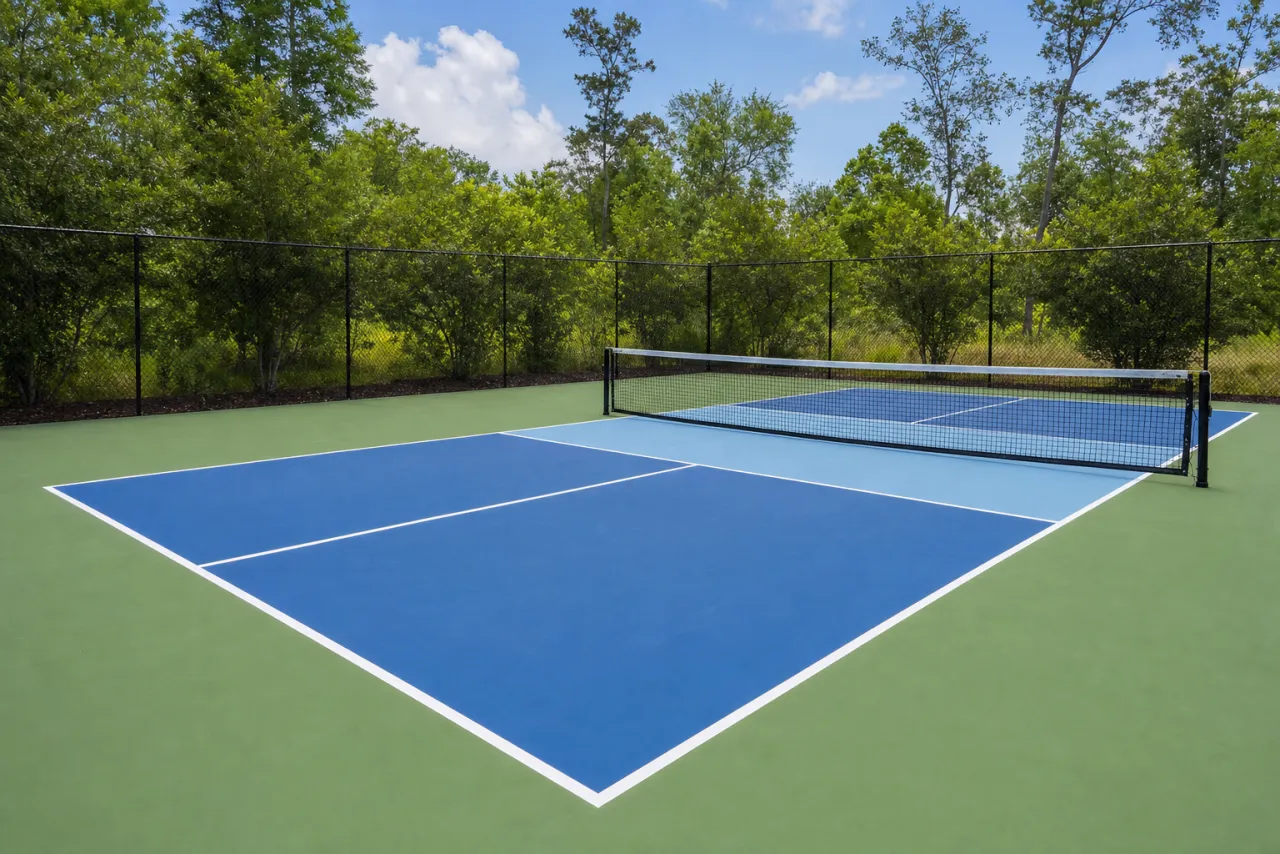
Pickleball is the fastest-growing sport in the US, and a well-built court is a real asset to a property, HOA, or club. The court itself is small, but the construction process is more involved than most people expect — and the small details determine whether the surface plays well for 5 years or 25.
Regulation dimensions (from USA Pickleball)
Per the official USA Pickleball rulebook:
- Playing court: 20 feet wide × 44 feet long (same for singles and doubles)
- Non-volley zone ("kitchen"): 7 feet deep on each side of the net
- Line width: 2 inches; measurements are taken to the outside edge
- Net height: 36 inches at the sidelines, 34 inches at the center
- Minimum total area: 30 × 60 feet (recommended)
- Preferred total area: 34 × 64 feet (allows comfortable safety margin behind baselines)
The 20×44 is the painted court. The 30×60 to 34×64 is the total surface that needs to be paved, fenced, and accessible.
Step 1: Site selection and layout
Before any equipment shows up, the site has to be evaluated for:
- Sun orientation: Courts are ideally oriented north-south so the sun isn't directly in either player's eyes at peak hours. East-west works but creates glare problems at sunrise and sunset.
- Drainage: The site needs to shed water in a single direction at 1% slope. Low spots that collect water will destroy the surface within a few seasons.
- Access: Heavy equipment (paving machines, rollers, materials trucks) needs to reach the site. Tight back-yard sites sometimes require alternative equipment or hand work.
- Setbacks: Check HOA, zoning, and setback requirements before laying out the court. A court built 6 inches into a setback is a court that gets removed.
Step 2: Excavation and sub-base
This is the part players never see and the part that determines whether the court lasts. The build:
- Excavate the existing soil down 8–12 inches across the full court area plus a 2–3 foot perimeter.
- Compact the sub-grade. The native soil at the bottom of the excavation needs to be stable before anything goes on top.
- Lay 6+ inches of compacted aggregate base. Crushed stone, compacted in lifts. This is the structural layer.
- Establish the slope. A pickleball court needs about 1% slope (1/8" per foot) in a single direction for drainage. Too flat and water sits. Too steep and the ball rolls.
If the base prep is rushed, no amount of surface quality will save the court. Most premature court failures trace back to inadequate base.
Step 3: Asphalt placement
Asphalt is the typical surface material for outdoor courts in our climate. Concrete is also used but is more expensive and harder to repair.
- Thickness: 2.5–3 inches of asphalt placed in one or two lifts, compacted to design density.
- Mix design: A finer-aggregate mix than standard road asphalt — gives a smoother, tighter surface for the color coating that comes next.
- Cure time: 30 days minimum before color coating. The asphalt needs time to off-gas; rushing this step causes the color system to bubble or fail.
Step 4: Color coating system
The bright greens, blues, and tans you see on pickleball courts come from a multi-layer acrylic system applied over the cured asphalt:
- Acrylic resurfacer. Fills the surface texture and creates a uniform base. Usually 1–2 coats.
- Color coat. The actual playing surface color. 2 coats minimum. Common pairings: green court with darker green kitchen, blue court with green surround, or various brand color schemes.
- Texture additive. Fine silica sand mixed into the color coat to give the surface the right amount of grip without being abrasive.
The color system also offers cushioning options — for residential and HOA installations, a cushioned acrylic system makes the court easier on knees and ankles. Worth the upgrade for most home installations.
Step 5: Line striping
Lines are applied last, using a contrasting color (typically white) and a court-paint formulated to bond with the acrylic color coat. Templates and laser tape ensure the geometry is exact — the 2" line width and proper dimensions matter for tournament play.
Step 6: Net posts and accessories
Two options for nets:
- Permanent posts: Set in concrete footings during the base prep stage. More stable, look better, slightly more expensive.
- Portable nets: No footings required. Cheaper, more flexible, easier to convert the surface to other uses.
Most dedicated pickleball courts use permanent posts. Multi-use surfaces often use portables.
Step 7: Fencing and finishing
A standard pickleball court fence is 10 feet tall on the back and sides, with mesh small enough to catch the ball. Black-coated vinyl fence is the most common look. Gates should be wide enough to allow equipment access for future maintenance.
Common configurations
- Single court: Standard residential or small HOA. ~30×60 footprint.
- Side-by-side dual: Two courts sharing a center fence. Common at clubs and parks.
- Four-court complex: 2×2 layout. Common at dedicated pickleball facilities.
- Tennis-court conversion: One tennis court can fit 4 pickleball courts with blended lines, or be permanently restriped for pickleball only.
Timeline
A typical single-court build runs:
- Site prep and excavation: 2–3 days
- Base and asphalt: 2–3 days
- Asphalt cure: 30 days (no work happening — but the calendar is ticking)
- Color coating and striping: 3–5 days, weather dependent
- Net posts and fencing: 1–3 days
End to end: 6–8 weeks from groundbreaking to first game, with the cure period being the long pole.
The bottom line
A pickleball court done right is a 20+ year asset. Done with shortcuts on the base or rushed cure, it'll need surface work in 3–5. The visible parts cost about the same; the difference is in the parts under the surface and the patience between steps.
Reference: USA Pickleball Official Rulebook