
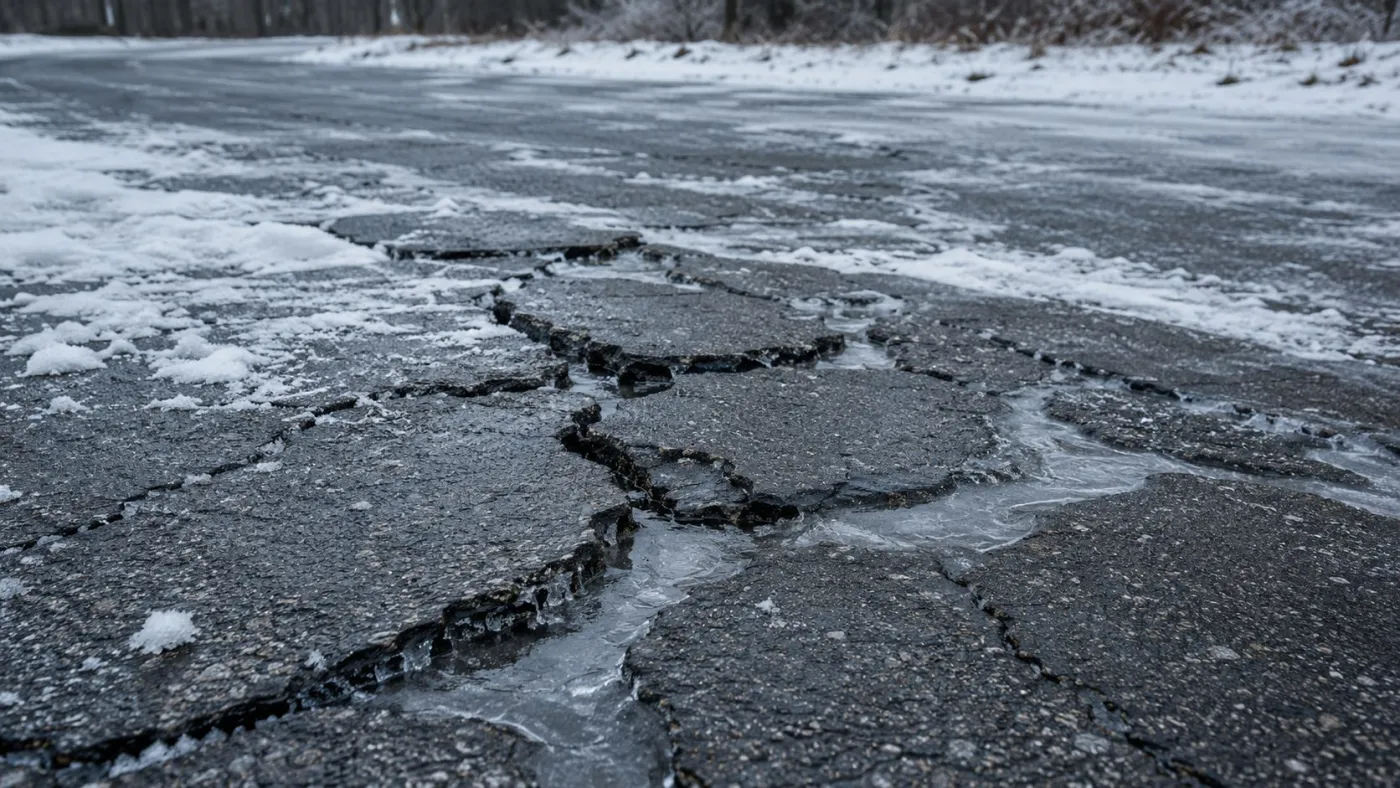
Asphalt's worst enemy isn't traffic, sun, or even ice. It's water that freezes inside the pavement. The Piedmont and Southern Virginia see somewhere between 30 and 50 freeze-thaw cycles every winter, and each one is a tiny wedge driven into the surface. Over years, those tiny wedges add up to the difference between a 30-year driveway and a 15-year one.
What freeze-thaw actually does
The mechanics:
- Water finds an opening in the surface — a hairline crack, a joint, an edge.
- The temperature drops below freezing.
- The water in the crack expands as it turns to ice — about 9% volume increase.
- That expansion pushes the crack walls apart slightly.
- Temperature rises above freezing. Ice melts.
- Now the crack is slightly wider, and more water can enter.
- Repeat. Often two or three times in a 24-hour stretch.
Each cycle adds a fraction of a millimeter. Multiply by 30–50 cycles per winter, over 5–10 winters, and a hairline crack becomes a half-inch crack — and from there, alligator pattern, then potholing.
Where NC and VA fall on the freeze-thaw map
The Piedmont sits in a particularly bad zone for asphalt because winters here are mild but not consistent. We don't have the deep, sustained freeze of New England — but we have lots of nights below 32°F followed by days above it.
- Triad cities (Greensboro, Winston-Salem, High Point, Burlington): roughly 35–50 freeze-thaw events per year
- Southern Virginia (Danville, Martinsville): slightly more, with elevation pushing closer to 50–60 events
- Coastal areas of NC: fewer cycles, less damage
- Mountain areas (Western NC, southwest VA): deep freeze means fewer thaw events; counterintuitively, the damage pattern is different
The four ways to break the cycle
1. Seal the surface before winter
Sealcoating is the single highest-impact thing you can do. Sealcoat closes hairline surface cracks and blocks water from entering. A driveway with a fresh seal heading into winter loses dramatically less ground than one with a year-old, dried-out seal.
Fall (September–early October) is the ideal time to sealcoat in our region. Spring works too, but you'll have already gone through one winter of damage by then.
2. Crack-fill anything visible
Any crack wider than 1/8" should be filled before winter. Cold-pour crack filler costs $20 a tube at any home improvement store and takes 30 minutes to apply to a typical residential driveway. The math is absurd — you can prevent thousands in eventual damage for the cost of a pizza.
3. Fix drainage
Standing water on or near the driveway is where most freeze-thaw damage starts. If you have a low spot that holds water after rain, that's the spot that'll freeze, expand, and propagate the most damage all winter. Fix drainage before sealcoating — sealing over a drainage problem just postpones the failure.
4. Salt smarter
Standard rock salt (sodium chloride) is hard on both asphalt and concrete. It accelerates surface scaling and oxidation, and the brine that runs off attacks the binder. Some safer alternatives:
- Calcium chloride works in colder temperatures than rock salt and is somewhat less destructive to asphalt at typical use rates.
- Magnesium chloride is even gentler and works to lower temperatures.
- Sand doesn't melt anything but provides traction and is completely safe for pavement.
- Calcium magnesium acetate (CMA) is the most asphalt-friendly de-icer; pricier but worth it for premium driveways.
Use any de-icer at the recommended rate, not at "more is better" rate. Apply early before ice forms, not after. And shovel first — you're trying to prevent ice formation, not melt accumulated layers.
What snow removal practices help
- Use a plastic shovel rather than metal. Metal blades nick the surface.
- If you use a snow plow service, ask about plastic or rubber blade edges.
- Don't pile snow on the same spot every storm — concentrated melt and refreeze beats up that area.
- Clear within 24 hours when possible. Snow that compacts under foot traffic refreezes into ice that's brutal to remove.
The springtime damage assessment
Walk the driveway in early spring and look for:
- New cracks that weren't there in October
- Existing cracks that have visibly widened
- Spots where the surface feels softer or shows visible aggregate
- Any new low spots or settled areas
The earlier you catch winter damage, the cheaper it is to fix. Crack-fill in March costs almost nothing; repaving in five years because of accumulated freeze-thaw damage costs everything.
The bottom line
Winter is hard on asphalt in our climate — but it's a predictable enemy. Seal before October, fill cracks, fix drainage, salt thoughtfully, and walk the property in March. Do that for ten years and your driveway will outlive its neighbor's by a decade.