
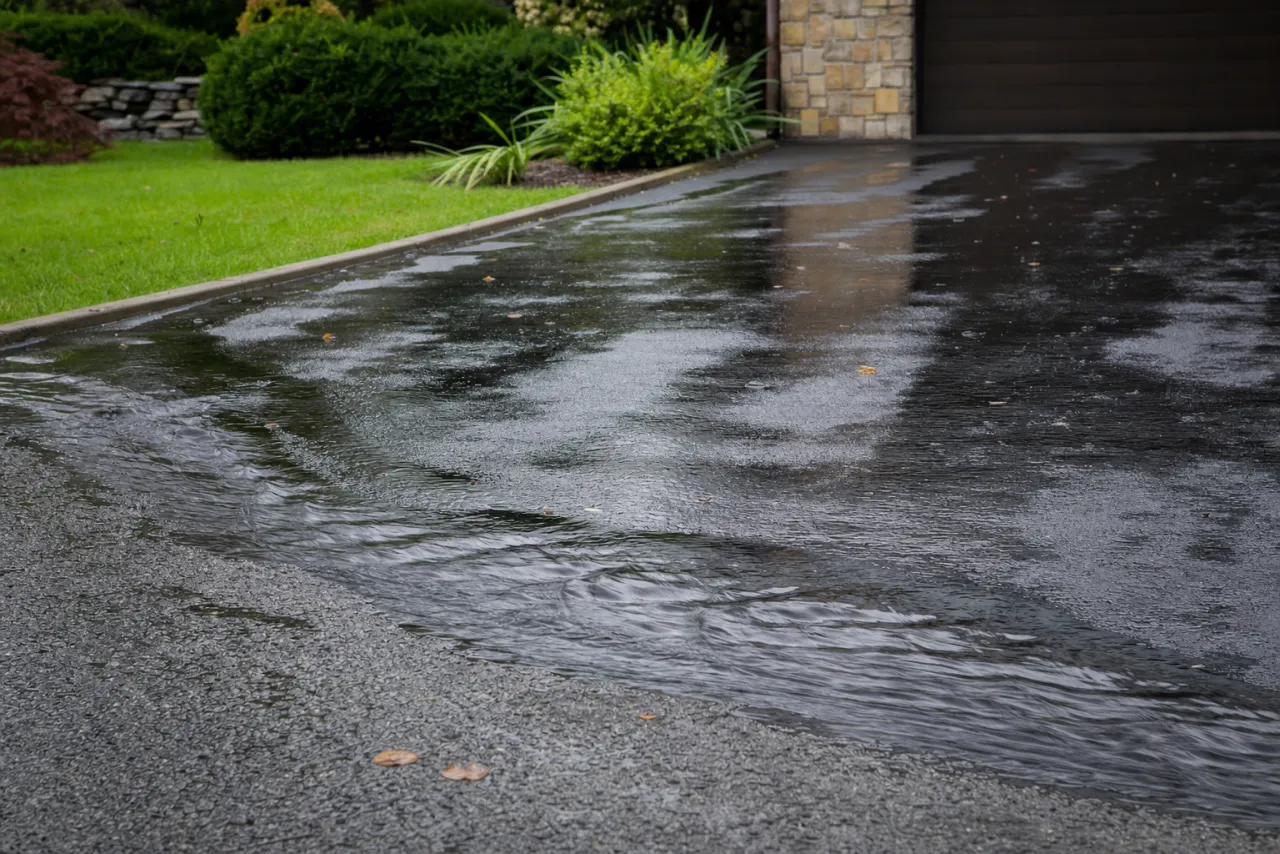
Ask any paving contractor what kills driveways early and the answer is almost always "water in the wrong place." Asphalt is designed to shed water; when it can't, every other failure mode accelerates. Drainage is the invisible reason a driveway lasts 30 years or 15.
How water destroys asphalt (briefly)
Water damages pavement in four ways:
- It softens the base. The sub-base under your asphalt is gravel or stone designed to spread loads. Saturated, it loses bearing strength.
- It carries fines. Slow-flowing water under the slab strips small particles (fines) out of the base, hollowing it out from below.
- It freezes and expands. Water in any crack expands ~9% when it freezes, prying the crack wider.
- It oxidizes binder. Standing water accelerates the chemical aging of the asphalt binder.
The driveway that's underwater for 24 hours after every rain is being killed by all four at once.
What good drainage looks like
A correctly designed driveway has three things working in its favor:
1. Adequate slope
Asphalt should slope at 1–2% minimum to shed water (about 1/8" to 1/4" per foot). Less than 1% and water sits. More than 8% gets hard to drive on safely.
Slope should run away from the house and toward a drainage path — usually the street, a yard swale, or a drain inlet.
2. Crown or cross-slope
On wider driveways and lots, a slight crown in the middle helps water move sideways toward the edges instead of sitting along the centerline.
3. Defined endpoint
Water has to go somewhere. A driveway that slopes water nicely to its lowest corner — and then dumps it into a flower bed where it sits — has just moved the problem instead of solving it.
The five drainage problems we see most
1. Reverse slope (water flows toward the house)
Common when a house was built before the driveway was paved, or when settlement has changed the original grade. Water headed toward your foundation is a structural problem long before it's a pavement problem. Fix this first.
2. Birdbath low spots
Localized depressions that hold water after rain. These start as cosmetic complaints and turn into structural failures over a couple of winters as the standing water saturates the base.
Small birdbaths can be filled with a skin patch (a thin overlay just over the low area). Larger ones need to be cut out and rebuilt.
3. Edge erosion
The soil along the edge of the driveway washes out, leaving the asphalt edge unsupported. The first car wheel that rides over the unsupported edge cracks it. Then water gets into the crack. Then the edge crumbles.
Fix: regrade and seed the edge, install edge stone, or pour a concrete apron at the unsupported sections.
4. Inadequate slope on long driveways
Long flat driveways sometimes look fine but drain poorly because the rise from end to end is tiny. A 100-foot driveway with a 6-inch fall has 0.5% slope — half the minimum. Sometimes the answer is regrading; sometimes it's adding a channel drain at the low end.
5. Tied-in storm infrastructure that's failing
On commercial properties, a parking lot may drain perfectly into its catch basins — and then those catch basins back up because the storm sewer downstream is undersized for current rainfall patterns. The asphalt looks like it's failing; the actual problem is downstream.
Drainage fixes from cheapest to priciest
- Regrading the surrounding soil. Sometimes a yard regrade is enough to get water moving the right direction.
- Edge stones, concrete edge, or pavers along the edge. Stops edge erosion.
- French drain along the side or downhill edge. Buried perforated pipe in gravel captures water before it reaches the pavement.
- Channel drain (trench drain) across the driveway. Grate-covered drain that intercepts water moving down the driveway. Common at garage thresholds.
- Surface regrading the driveway itself. Mill off the old surface, re-establish proper slope, repave. This is the only fix that works when the driveway itself has the wrong slope built in.
- Full reconstruction. When base saturation has already damaged the structural section, you sometimes have to rebuild from the dirt up.
A 5-minute drainage check
Walk your driveway about 30 minutes after a heavy rain. Look for:
- Standing water anywhere on the surface (mark these spots)
- Water flowing toward, not away from, the house
- Erosion in soil at the edges
- Wet spots that persist long after the rain has stopped
- Visible water staining on the lower edge of the garage door
If you find any of these, fix them before scheduling sealcoating, crack-fill, or any other surface work. Surface treatments over a drainage problem are wasted money.
The bottom line
You can do everything right with maintenance — seal every two years, fill every crack — and still lose a driveway in 15 years if water is sitting on it after every rain. Get drainage right and the rest of asphalt care is the easy part.