
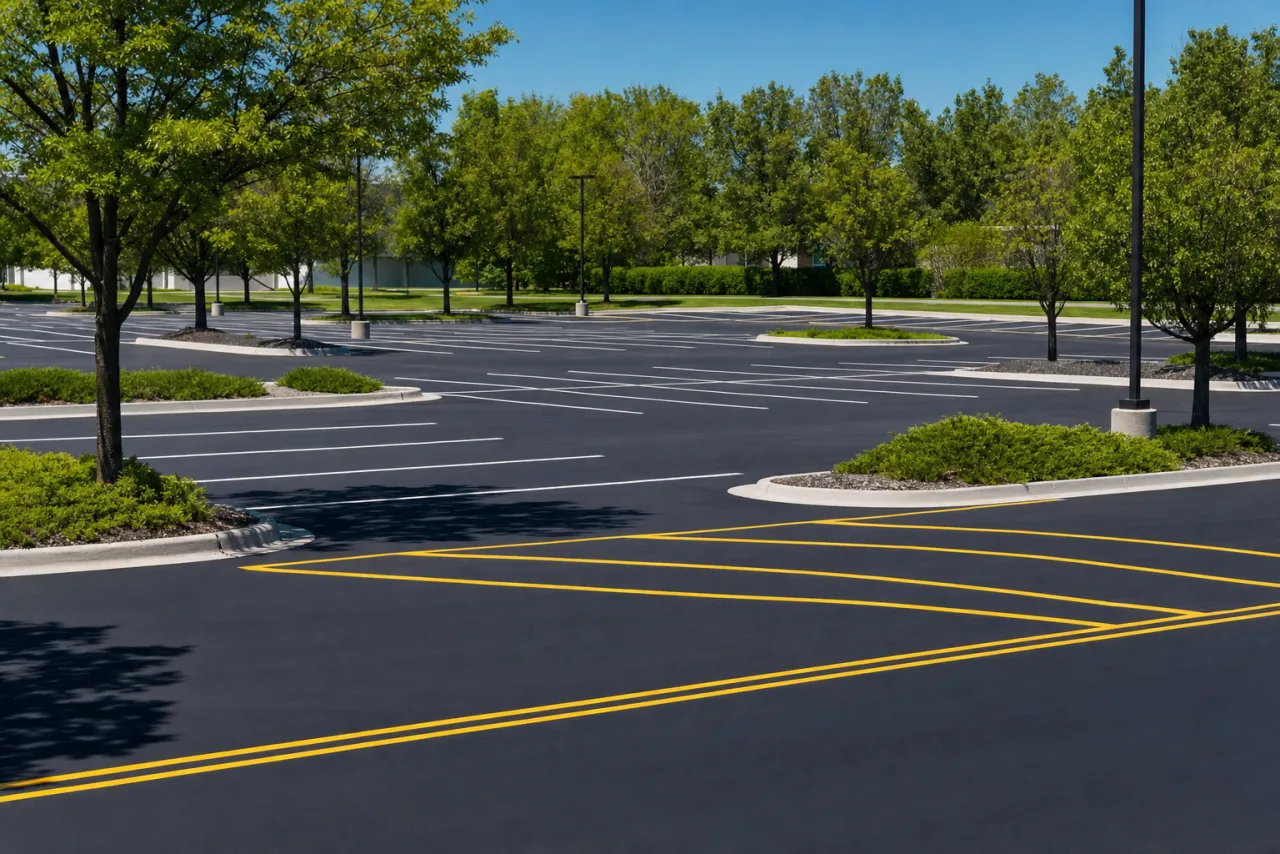
Parking lot striping looks simple — it's just paint on asphalt. In practice, the choices around stall size, angle, paint type, and refresh cycle have big effects on lot capacity, safety, ADA compliance, and how long the striping actually lasts. Here's a practical guide for property managers and business owners.
Standard stall dimensions
There's no universal national standard, but typical commercial stall sizes are:
- Compact: 8'-0" wide × 16'-0" long
- Standard: 9'-0" wide × 18'-0" long (most common)
- Premium: 9'-6" wide × 18'-0" or 19'-0" long
- SUV/truck preferred: 10'-0" wide × 19'-0" long
- ADA standard: 8'-0" wide minimum with 5'-0" access aisle
- ADA van: 11'-0" wide with 5'-0" aisle (or 8'-0" with 8'-0" aisle)
Local codes sometimes override these. Check your jurisdiction; municipal codes can specify minimums (especially in urban areas with parking lot ordinances).
Angle vs. perpendicular
90° (perpendicular)
The standard. Maximum capacity for a given lot area. Two-way drive aisles required (typically 24 feet).
Use when: You're optimizing for raw capacity and you don't have flow concerns.
60° angled
Good compromise between capacity and easy entry. One-way traffic flow required.
Use when: Drive aisles are tight (one-way flow lets you use narrower aisles, around 18 feet).
45° angled
Easiest entry/exit, especially for SUVs and trucks. Lowest capacity per square foot. One-way flow required.
Use when: Customer experience matters more than max capacity (medical offices, restaurants, retail with elderly customers).
30° angled
Specialty use only. High customer-experience value, very low capacity.
Layout fundamentals
Beyond just stalls and aisles, a well-striped lot has:
- Clear traffic flow. Arrows on the pavement, stop bars at exits, no-parking zones at corners.
- Fire lanes. Typically 18–20 feet wide, marked "FIRE LANE" with red curbing. Required adjacent to most commercial buildings.
- Loading zones. If trucks deliver, dedicated loading area saves grief.
- Pedestrian crosswalks. Especially in front of building entrances, often with continental ("zebra") striping.
- Cart corrals. For retail; designated areas prevent carts from roaming.
- ADA spaces and path of travel. Per the rules — see our ADA parking requirements guide.
Paint types
Latex/water-based traffic paint (most common)
Pros: Cheapest. Dries fast. Low VOC. Easy to apply.
Cons: Shortest lifespan — typically 1–2 years in high-traffic areas, 2–3 years in lower-traffic spots.
Use when: Standard commercial restriping on a 2-year refresh cycle.
Solvent-based traffic paint
Pros: Better adhesion than water-based. Works in cooler temperatures.
Cons: Slower drying. Higher VOC content. Slightly more expensive.
Use when: Cooler-weather striping or where water-based isn't holding up well.
Thermoplastic
Pros: Long lifespan (5–8 years). Brighter color. Reflective glass beads embedded for night visibility.
Cons: More expensive. Requires heated application equipment. Doesn't adhere well to seal-coated surfaces.
Use when: Roadways, high-traffic commercial lots, areas where night visibility matters.
Epoxy
Pros: Very durable. Resistant to chemicals and oils.
Cons: Most expensive option. Long curing time.
Use when: Industrial sites, fuel stations, or specialty environments.
Refresh cycles
How often you restripe depends on use, paint type, and your standards:
- Standard commercial retail: Every 2–3 years with latex paint
- High-traffic lots (grocery, big box): Every 18 months
- Medical/professional: Every 2–3 years (visual quality matters more)
- Office buildings: 3–4 years (lower traffic, less wear)
- Schools and churches: 3–5 years (low daily use)
Restriping is also the right time to revisit ADA compliance and any new layout needs (added EV charging spots, updated cart corrals, etc.).
Capacity optimization
If you have a tight lot and want to maximize stalls, here are the tradeoffs:
- Compact-only sections. Compact stalls fit more cars per foot. Most building codes allow a percentage of compact spaces (usually 20–25% of the total).
- Narrower stalls. Going from 9'-0" to 8'-6" wide gains capacity but customer satisfaction drops, door-ding complaints rise.
- Angled parking with one-way flow. Can fit more cars in narrow lots compared to 90° with two-way drive aisles.
- End cap stalls. The space next to the drive entrance/exit is often wasted. A small stall at the end of a row uses that space.
When to combine striping with sealcoating
Sealcoating and striping go together. If your lot is due for sealcoating, do the striping immediately after — the new color coat erases the old lines anyway, and you get a fresh, clean look. The sequence:
- Sealcoat the entire lot.
- Let it cure 24–48 hours.
- Pre-mark stall locations (chalk lines or laser).
- Apply new paint with striping machine.
- Open the lot.
The whole sequence is usually 2–3 days for a small lot, scaled up for larger properties.
The bottom line
Good striping makes a lot feel safer, look more professional, and use space more efficiently. Bad striping makes a lot look neglected and creates ADA exposure. Pick the right paint for your refresh cycle, plan layout carefully when restriping anyway, and make sure ADA compliance is in the scope every time you do the work.