
If you own or manage a commercial property with parking, ADA compliance isn't optional. The standards have been in place since the 2010 ADA Standards for Accessible Design, and enforcement is real — both via direct DOJ action and private lawsuits. The rules aren't complicated, but they're specific. Here's what you need to know.
How many accessible spaces do you need?
This is governed by Table 208.2 of the 2010 ADA Standards. The required minimums scale with total parking count:
- 1 to 25 spaces: 1 accessible space
- 26 to 50 spaces: 2 accessible
- 51 to 75 spaces: 3 accessible
- 76 to 100 spaces: 4 accessible
- 101 to 150 spaces: 5 accessible
- 151 to 200 spaces: 6 accessible
- 201 to 300 spaces: 7 accessible
- 301 to 400 spaces: 8 accessible
- 401 to 500 spaces: 9 accessible
- 501 to 1,000 spaces: 2% of total
- 1,001+ spaces: 20 accessible plus 1 per each 100 over 1,000
Special facility categories have stricter ratios:
- Hospital outpatient facilities: 10% of patient/visitor spaces must be accessible
- Rehabilitation facilities and outpatient physical therapy: 20% of patient/visitor spaces must be accessible
Van-accessible spaces
At least one out of every six accessible parking spaces (or fraction thereof) must be van-accessible. That means:
- 1–6 accessible spaces required → 1 must be van-accessible
- 7–12 accessible spaces required → 2 must be van-accessible
- And so on
Every parking facility needs at least one van-accessible space, regardless of size.
Space dimensions
Standard accessible space
- Parking space width: 96 inches (8 feet) minimum
- Access aisle width: 60 inches (5 feet) minimum
- Length: Same as standard spaces in your lot
Van-accessible space
- Parking space width: 132 inches (11 feet) minimum, OR a 96-inch space with a 96-inch access aisle
- Access aisle width: 60 inches (5 feet) minimum if using the 132-inch space; 96 inches if using the alternative width
- Vertical clearance: 98 inches (8'-2") minimum from grade through the parking space, access aisle, and the route the van takes to enter/exit
Two accessible spaces can share a common access aisle between them — this is the most common configuration.
Slope and surface
Accessible parking spaces and access aisles must be nearly level:
- Maximum slope of 1:48 (about 2%) in all directions
- Cross slope and running slope both apply
- This is stricter than the slope of typical parking lots — flat is required, not just gentle
The surface must also be:
- Stable, firm, and slip-resistant
- Free of changes in level exceeding 1/4" (vertical) or 1/2" (with a beveled transition)
Location
Accessible spaces must be located:
- On the shortest accessible route to the building entrance(s) they serve
- If there are multiple accessible entrances, accessible spaces are dispersed among them
- For employee-only lots, near the employee entrance
- For medical care and outpatient facilities, near the accessible entrance providing the primary care
Signage
Every accessible space requires:
- A vertical sign with the International Symbol of Accessibility, mounted at a minimum of 60 inches above ground (measured to bottom of sign)
- For van-accessible spaces, additional "Van Accessible" designation
- Signs must remain visible when a vehicle is parked in the space
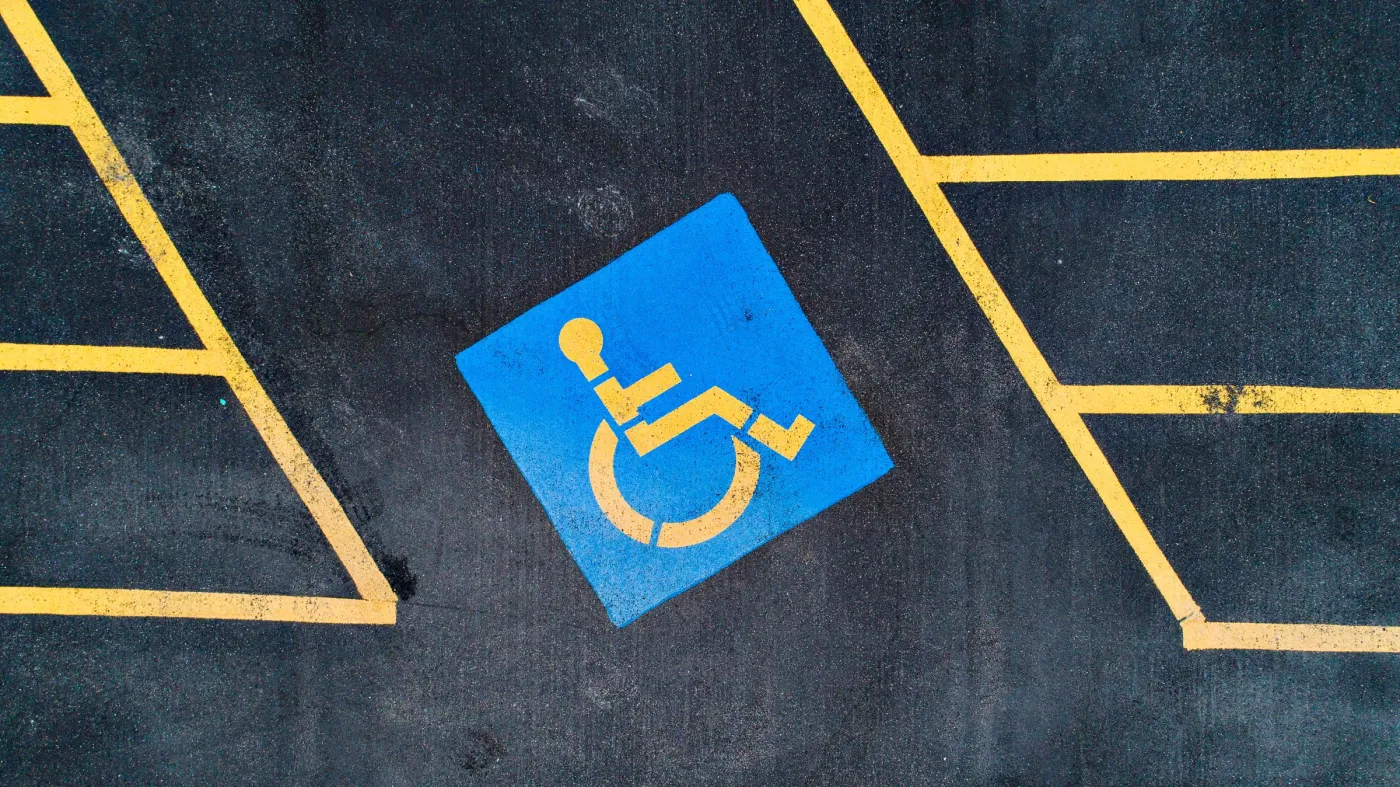
The painted symbol on the pavement is optional under federal rules but commonly required by state and local codes. Many jurisdictions also require the access aisle to be marked with diagonal hatching in a contrasting color.
Path of travel
Accessible parking is useless if the path from the space to the entrance has barriers. You need:
- A continuous accessible route from the access aisle to the building entrance
- Curb ramps where the path crosses a curb (running slope max 1:12, with proper transitions)
- No vehicles or other obstructions blocking the route
Common violations we see
- Wrong slope. Accessible spaces re-striped over a sloping lot without leveling. This is the single most common violation.
- Faded or missing signage. The sign is required to be visible; faded paint or missing posts are violations.
- Access aisle blocked by snow piles, shopping carts, or vehicles. The aisle has to stay clear.
- Path of travel interrupted. Cracked pavement, missing curb ramps, or obstructions break compliance even if the space itself is fine.
- Not enough van-accessible spaces. Old lots often have multiple accessible spaces but none designated van-accessible.
What restriping triggers
The ADA's "readily achievable" standard applies — meaning existing parking lots don't have to be brought fully into compliance overnight, but improvements have to happen when you do work on the lot anyway. When you restripe or repave, you're effectively required to bring the lot up to current accessibility standards.
This is the moment most property managers face the compliance question: you scheduled a routine restriping and your contractor tells you the accessible spaces don't meet code. Better to address this proactively than find out from a complaint.
The bottom line
ADA parking requirements aren't complicated, but the details — slope, dimensions, signage, path of travel — matter. The next time you're planning parking lot striping or repaving, make compliance part of the scope from day one. Fixing accessibility at the same time as routine work is dramatically cheaper than fixing it later under enforcement pressure.
Reference: ADA.gov Accessible Parking Spaces